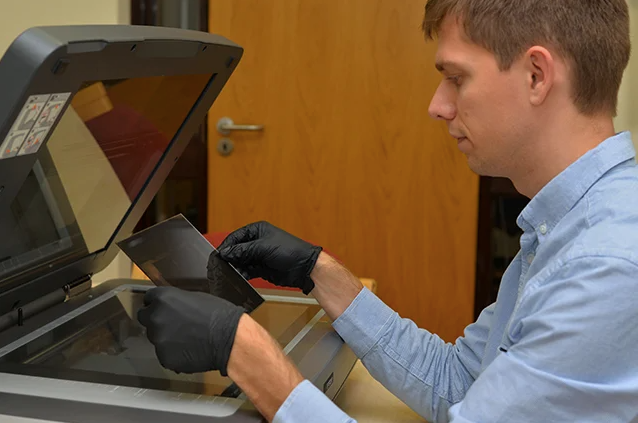

Negatives and glass plates contain irreplaceable images, but their physical fragility makes handling risky. Acetate film base deterioration, brittle emulsion layers, and cracked glass all pose a threat to loss during scanning attempts.
Professional methods to convert negatives to digital formats prioritize preservation over speed, using specialized equipment and handling protocols that protect originals while capturing maximum image detail.
Here are five pro tips for digitizing fragile film materials safely.
#1 Use Transmitted Light Scanning Techniques for Fragile Film Materials
Reflective scanners designed for prints fail with transparent negatives. Film requires transmitted-light scanning techniques that pass light through the material rather than bounce it off the surface.
Professional film scanners provide:
- Even backlighting that eliminates hotspots and shadows.
- Anti-Newton ring glass that prevents interference patterns.
- Film holders that support fragile materials without bending.
- Variable light intensity adjusted for film density.
Flatbed scanners with transparency adapters work for stable negatives but lack the precision that film scanners offer for damaged or warped materials.
#2 Follow Archival Film Handling Protocols to Prevent Physical Damage
Film emulsion scratches easily, and oils from skin contact cause permanent damage.
Archival film handling protocols reduce these risks:
- Cotton gloves are worn during all handling to prevent oil transfer.
- Film held only by edges, never touching image areas.
- Work surfaces are cleaned and free of debris before placing film.
- Curled film flattened gradually using weighted glass, not force.
Damaged film requires additional care. Brittle acetate snaps under pressure. Cracked glass plates separate into pieces if tilted incorrectly.
#3 Identify Film Types Before Digitization (Nitrate, Acetate, Wet Plate Collodion)
Different film bases require different digitization approaches:
| Film Type | Date Range | Key Characteristics | Handling Notes |
| Nitrate | 1890s-1950s | Yellowing, brittleness, vinegar smell | Extremely flammable, degrades rapidly |
| Acetate (Safety Film) | 1920s-1990s | Clear base, may show vinegar syndrome | Shrinks and warps as it deteriorates |
| Wet Plate Collodion | 1850s-1880s | Glass backing, visible emulsion texture | Glass cracks easily, emulsion flakes off |
| Dry Plate | 1870s-1920s | Glass backing, thinner emulsion | Glass brittle, emulsion lifts at edges |
Digitizing nitrate negatives safely requires immediate action. Nitrate film self-destructs as it ages, releasing acidic gases that accelerate decay.
#4 Address Acetate Film Base Deterioration Before Scanning
Vinegar syndrome causes film to shrink, warp, and release acetic acid. Advanced stages produce sticky surfaces, channeling, and complete image loss.
Early-stage vinegar syndrome film can still be scanned if handled properly:
- Film is separated from other materials to prevent acid spread.
- Warped film flattened using non-adhesive weighted methods.
- Scanning completed quickly to minimize handling time.
- Originals stored in cold, dry environments post-digitization to slow further decay.
Late-stage vinegar syndrome film may be too fragile to scan without causing additional damage.
See also: How to Buy Bus Tickets Online Using Your Phone
#5 Capture Maximum Detail with High-Resolution, Low-Handling Scanning Methods
Fragile negatives cannot tolerate multiple scan attempts. High-resolution captures on the first pass reduce the need to rescan materials that degrade with each handling event.
Professional glass plate negative digitization uses:
- Resolution settings between 2400-4000 DPI, depending on plate size.
- Single-pass scanning to minimize handling.
- Custom film holders that stabilize cracked or warped materials.
- Dust removal is performed digitally rather than physically cleaning fragile surfaces.
Glass plates present unique challenges. Cracked plates require scanning before the pieces separate. Wet plate collodion preservation depends on capturing images before the emulsion layer detaches from the glass backing entirely.
Why Professional Photo Scanning Services Are Safer for Fragile Materials Than DIY Methods?
Home scanning equipment lacks the specialized features and trained handling that fragile film requires.
Professional services provide advantages that DIY methods cannot match:
- Specialized film scanners are designed for fragile materials.
- Technicians trained in archival film handling protocols.
- Controlled environments that prevent static, dust, and humidity damage.
- Insurance coverage for materials in case of accidental loss.
For nitrate film, professional facilities offer storage and scanning environments that manage flammability risk appropriately. For severely deteriorated acetate, professionals assess whether scanning is possible or if materials are too fragile to handle safely.
Closing Thoughts
Fragile negatives and glass plates deteriorate whether scanned or not. The question is whether images are captured before materials degrade past the point of recovery.
Professional digitization protects originals through specialized equipment, trained handling, and workflows designed for preservation rather than speed. Materials scanned correctly yield high-resolution digital files that outlast the fragile originals they replace.


 By
By


 By
By