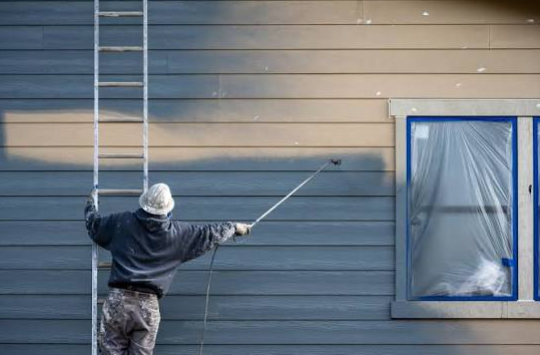

Repainting tired hardboard siding is usually the more expensive choice, not the thrifty one. That reads backwards to most homeowners, and I understand why, because a paint crew invoices a fraction of what a siding crew does and they are off the property inside a week. Stretch the same house across eighteen years, though, and the arithmetic flips. Three repaints at, say, six thousand dollars a coat is roughly eighteen thousand dollars spent on a wall that still has the same swollen board sitting behind it. The crews handling siding west jordan ut replacements watch the tail end of that math play out every spring. So here is the argument, stated plainly. Once hardboard has started taking on water, replacing the siding costs less over the remaining life of the house than buying one more paint cycle.
Family Handyman ran a piece in April 2026 walking through why this material keeps shedding finish, and it lined up with what our guys had been muttering on ladders for years. Hardboard swells at the cut edges and the bottom courses, and that movement pushes the paint film off the board in 2-3 years anywhere sprinkler spray, gutter overflow or roof splash keeps landing on it. Worse, each repaint after that one fails quicker than the last, because the damage under the finish is cumulative and no primer reverses it.
Paint Fails Fastest Where Hardboard Drinks Water
Look at where your paint is actually failing before you look at anything else. On a 1992 two story with hardboard lap, the failure is almost never spread evenly across the elevation. It is the first two or three courses off the grade, the corners near a downspout, and the run of wall the lawn heads have been hitting since the Clinton administration. Everything above eye level can still look fine, which is exactly why the last painter told you the house had plenty of life left.
That pattern tells you the problem is water, not finish. Hardboard is wood fiber and resin pressed into a board, so the cut ends behave like the end of a sponge. Push a screwdriver into a low course on the sprinkler side. If the tip stops hard and the board rings, paint is still a reasonable purchase and you have time. If the tip sinks in a quarter inch and comes back with wet fiber on it, no coating sold anywhere is going to hold, and a bid to repaint that wall is a bid to spend money twice.
See also: Simple Mindset Shifts That Make Everyday Life Feel More Abundant
Questions I Get After The Second Repaint
The second repaint is when homeowners start asking real questions instead of shopping for a color. By then they have watched a fresh, warrantied paint job blister on the north side before the second summer ended, and the painter has already explained that the failure was the substrate rather than the product. That explanation is usually accurate and it never makes anyone feel better. Most siding west jordan ut estimates I write start with somebody standing in the driveway holding a paint chip they peeled off with a thumbnail. So here are the three questions that come up job after job, answered the way I answer them on the driveway.
Can I Just Replace The Bad Boards And Repaint?
Sometimes, and it is worth pricing. Swapping a dozen ruined courses on one elevation is genuinely cheaper than a whole house, and if the rest of the siding is sound it can be the right call. What I will tell you honestly is that matching profile and texture on eighteen year old hardboard rarely looks seamless, and the patched wall tends to start the same cycle again three or four years later because the sprinkler and the gutter that caused it are still there.
How Much Longer Will Another Paint Job Really Last?
On dry, sound board, eight to ten years is a fair expectation. On board that has already swelled and been repainted twice, plan on two summers and be pleasantly surprised if you get a third. I cannot give you a tidy number for the middle case, where half the wall is solid and half is soft, and anybody who quotes you one with confidence is guessing. That is the honest gap in this trade, since nobody tracks failure rates house by house.
Is Vinyl Or Fiber Cement The Better Replacement?
Both end the repaint cycle, which is the whole point, and the choice usually comes down to budget and how the house is detailed. Vinyl is the lower installed cost and it never needs paint. Fiber cement and composite carry a heavier, more traditional look that suits a two story with a lot of trim, and they cost more up front. What I find is that homeowners who plan to stay ten years or longer lean toward fiber cement, and homeowners eyeing a sale in three or four take the vinyl and are happy with it.
Replace The Siding And Stop Buying Paint Cycles
Run your own numbers before the next painter shows up with a bid. Add what you have already spent on coats since the house was new, add what the next one costs, then add the one after that, because on soft board there will be one after that. Set that total against a single replacement that comes with a labor warranty and never needs a brush again. At that point you are not painting a wall, you are painting a sponge, and the sponge always wins. Replacement is the option that finally ends the spending instead of scheduling it.


 By
By


 By
By